A selection of enterprise product and research engagements from my time at IBM Consulting.
/01 - American Electric Power
Modernizing field tools for one of the largest electric utility companies in the U.S.

Client
American Electric Power - 6 months
Focus Areas
IBM Consulting, Product Design, Mobile, UX/UI
During a six-month engagement with American Electric Power (AEP), I worked across two product initiatives focused on improving tools used by employees in the field.
My work spanned interaction and UI design, prototyping, user research, heuristic evaluation, and workflow analysis — from understanding complex legacy systems to designing simpler tools for employees in the field.
CAA - Customer Account Accounting
Making complex timesheets work on mobile
AEP field technicians needed to complete and submit timesheets while on the go. The existing workflow required users to enter large amounts of information across forms containing as many as 24 fields, creating a particular challenge on smaller screens.
I explored how this dense, data-heavy workflow could translate into a responsive mobile experience without sacrificing the information technicians needed to complete their work.
Designing for dense data
I explored multiple approaches for organizing large amounts of form data on mobile. Through iteration and user testing, we found that expandable sections provided a more usable approach than forcing technicians through horizontally scrolling screens.
I translated these findings into high-fidelity responsive designs and built an interactive prototype used to validate the experience with users.
My contribution
Designed responsive mobile workflows and high-fidelity UI
Explored interaction patterns for complex, data-heavy forms
Built a functional prototype for user testing
Partnered with research to evaluate and refine the experience
Field Mobility
Rethinking a legacy workflow for meter electricians
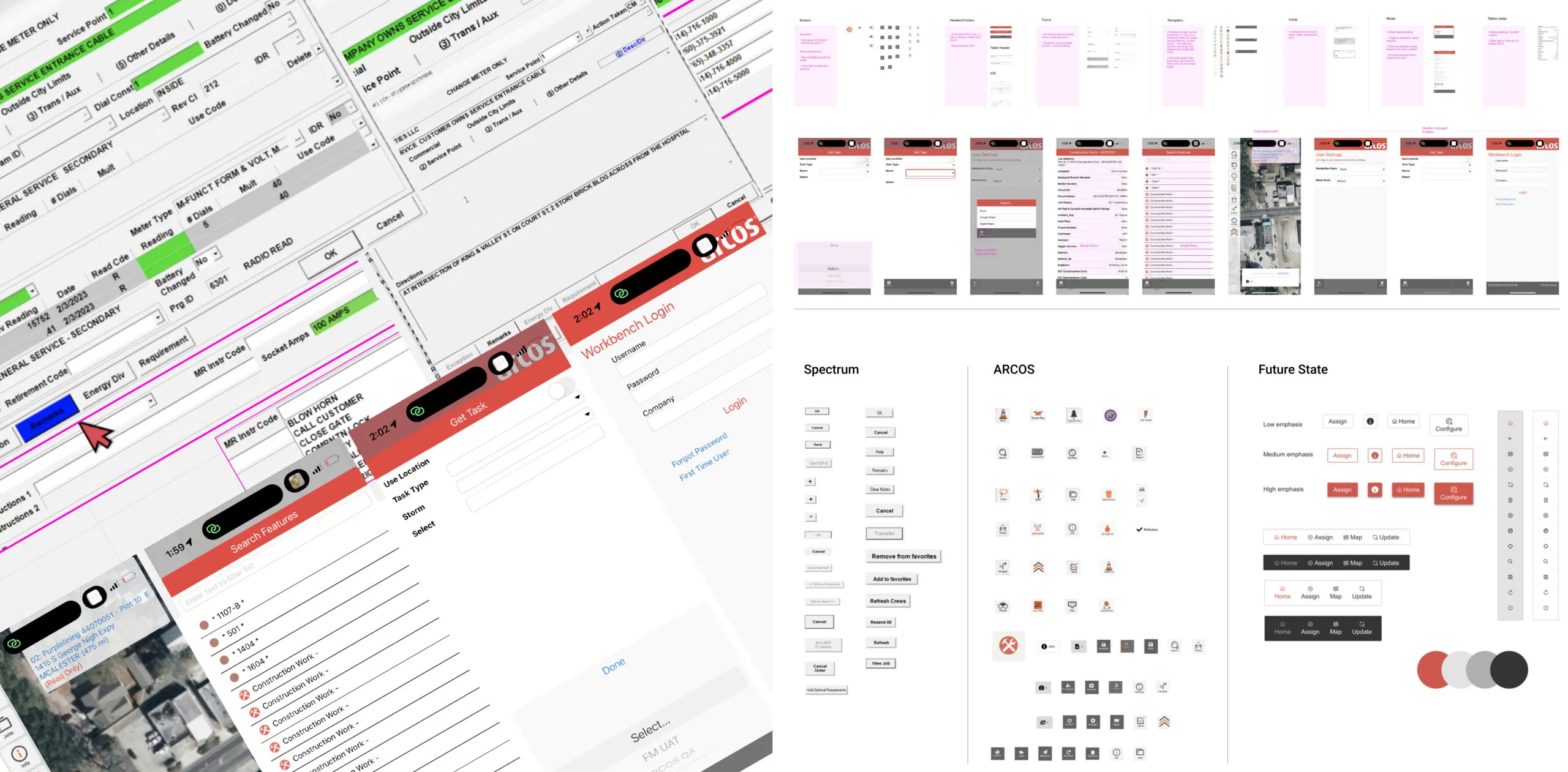
AEP's meter electricians relied on Spectrum, a legacy desktop system dating back to the 1990s, alongside other tools to complete complex meter changes, manage device inventory, and document work in the field. Our team was asked to understand the existing experience and identify opportunities for a more effective field application.

Understanding the current experience
I partnered with the research team to interview meter electricians and understand their workflows, pain points, workarounds, and the realities of completing jobs in the field.
I conducted a heuristic evaluation and gap analysis of the existing Spectrum and ARCOS experiences, identifying where the tools weren't adequately supporting technicians and where a future mobile experience could simplify their work.
Mapping the field experience
Working with the team, I mapped the end-to-end meter-change workflow — from reviewing job inventory and traveling to a job site through completing the work and documenting the result.
The analysis exposed where technicians moved between systems, encountered friction, and relied on manual workarounds, providing a foundation for the future-state experience.
From fragmented tools to a field-first experience
Using insights from the research, workflow analysis, and gap assessment, I developed UX and UI recommendations for a future field application designed around the needs of technicians completing work away from their desks.
Outcome
The engagement identified critical gaps across AEP's legacy field tools and established a future-state experience for modernizing priority workflows used by field technicians.

/02 - Pfizer
Uncovering opportunities to improve an internal investigation and analytics platform.

Client
Pfizer - 3 months
Focus Areas
IBM Consulting, UX Research, Healthcare
During a three-month engagement with Pfizer, I was tasked with leading UX research for Sherlock, an internal platform used by employees across different roles and regions.
The goal was to understand how employees were using the existing system, uncover pain points and gaps in the experience, and identify opportunities to make Sherlock more effective for its users.
Leading the research
I led the research effort from planning through stakeholder delivery. I developed the research plan, conducted remote 1:1 interviews with Pfizer employees across the U.S., Ireland, and Singapore, and synthesized the findings into user journeys spanning different roles and workflows.
I then translated the research into design recommendations and presented the findings and opportunities directly to Pfizer stakeholders.
Building the research strategy
I developed the research plan for the engagement, defining the approach, interview structure, and methods we would use to understand the existing Sherlock experience.
Because the platform supported employees with different responsibilities and workflows, it was important to capture perspectives across both roles and regions.
I conducted remote one-on-one interviews with Pfizer employees based in the United States, Ireland, and Singapore, spanning multiple roles and use cases.


From interviews to user journeys
I synthesized findings from the interviews into individual and collective journey maps, documenting how different users moved through Sherlock and where they encountered friction.
Mapping these experiences side-by-side helped reveal recurring pain points as well as differences in how employees used the platform depending on their role and objectives.
The research also surfaced opportunities to simplify workflows and better support the different ways employees searched for, analyzed, and worked with information within Sherlock.


Turning research into recommendations
Rather than ending the engagement with research findings alone, I translated the insights into actionable UX and design recommendations.
The final deliverable brought together the research findings, user journeys, identified pain points, and proposed opportunities for improving the Sherlock experience.
I presented the findings and recommendations to Pfizer stakeholders, providing the team with a research-backed foundation for future product improvements.
What the research revealed
01 — The core experience worked
Across roles, employees generally found Sherlock straightforward and effective for completing investigative workflows, particularly when locating historical records.
02 — Search created the greatest friction
Broad queries could return an overwhelming number of results, making it difficult for users to quickly identify records relevant to their investigation.
03 — Better filtering presented the clearest opportunity
The research identified search and filtering as the highest-value area for improvement. I recommended simplifying the interface and strengthening filtering and query controls to help users reach relevant information faster.
Outcome
I presented the findings and design recommendations to Pfizer stakeholders, providing the team with a research-backed understanding of how Sherlock was being used across roles and regions — and a prioritized set of opportunities for improving the experience.

/03 - Ahold Delhaize
Turning complex supply-chain architecture into a clear visual story for executive leadership.

Client
Ahold Delhaize - 3 months
Focus Areas
Information Design, Enterprise Strategy, Graphic Design
During a three-month engagement with Ahold Delhaize, I worked with a cross-functional IBM team to document the Forecasting & Replenishment value stream across ADUSA and RBS.
Through a series of three in-person workshops, the team mapped complex systems, data architecture, dependencies, and supply-chain processes to identify opportunities for improvement and support the organization's strategic priorities.
Making complexity understandable
My role focused on translating the team's highly technical findings into clear, digestible visual communication.
Working closely with a data architect, supply-chain expert, and project lead, I transformed complex data architecture and supply-chain processes into system maps, diagrams, and other visual frameworks that could be understood beyond the technical teams that created them.
I then brought these artifacts together into a 110-page executive document, establishing the visual hierarchy and information structure needed to turn a large body of interconnected technical information into a cohesive, legible narrative.
The final deliverable was presented to Ahold Delhaize executive leadership and helped communicate the current-state ecosystem, its complexity, and opportunities for future improvement.
Outcome
The engagement helped align technical and executive stakeholders around a clearer understanding of the Forecasting & Replenishment ecosystem and contributed to the IBM team securing a $1.4 million contract extension with the client.

